 AiBrain
 The 11 Multi-Agent Orchestration Patterns: Complete Guide
How to structure the collective intelligence of your AI agents
Related articles: AI Agent Design Guide | Building an Agent: The Building Blocks | Meta-Analysis of AI Agent Capabilities
Executive Summary
In brief: Multi-agent orchestration enables multiple AI agents to collaborate on solving complex problems. This guide presents 11 fundamental patterns — from the simple sequential Pipeline to the emergent Swarm — each suited to specific contexts. Patterns differ by their level of control (centralized vs distributed), complexity, and use case: Pipeline for linear workflows, Supervisor for intelligent routing, Fan-out/Fan-in for parallelization, Evaluator/Critic for iterative quality, Council for multi-expert decisions. The key: understand each pattern’s strengths and combine them like Lego bricks.
Multi-agent orchestration is the art of making multiple AI agents collaborate to solve complex problems. But how do you organize this collaboration? There are several patterns, each suited to specific contexts.
Here are the 11 fundamental patterns that every AI architect should master.
1. Pipeline — Sequential Processing
The Concept
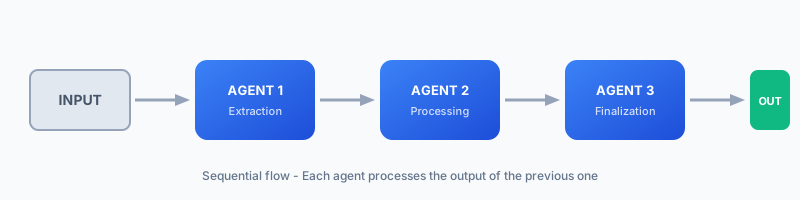
The Pipeline pattern organizes agents in a linear chain. Each agent processes the output of the previous one and passes the result to the next. Simple, predictable, efficient.
Diagram
When to Use
- Processes with well-defined sequential steps
- Cascading data transformations
- Workflows where each step depends on the previous one
Practical Case: HR Application Processing
A company receives 500 resumes per day. The pipeline:
- Extraction Agent → Parses the resume (PDF, Word) into structured data
- Scoring Agent → Evaluates job/profile fit (0-100)
- Enrichment Agent → Searches LinkedIn, portfolio, references
- Writing Agent → Generates a summary sheet for the recruiter
Result: 500 resumes processed in 2 hours instead of 3 days, with standardized sheets.
2. Supervisor — Centralized Delegation
The Concept
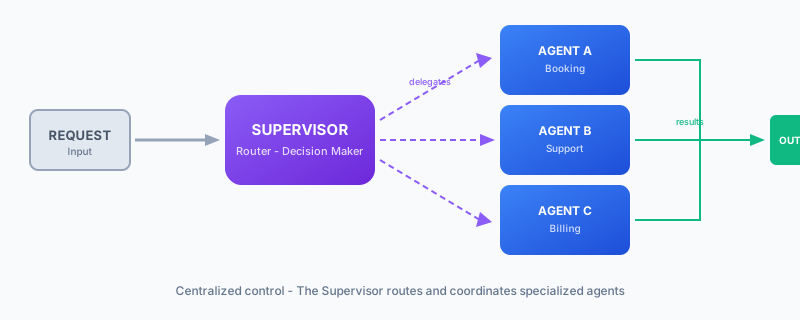
A central Supervisor agent receives requests, decides which specialized agent should intervene, delegates the task, then collects and synthesizes the results.
Diagram
When to Use
- Intelligent request routing
- Systems with specialized agents
- Need for centralized coordination
Practical Case: Multi-Brand Customer Support
A hotel group with 3 brands (luxury, business, budget):
- Supervisor → Analyzes customer request, identifies brand and request type
- Booking Agent → Modifications, cancellations, availability
- Concierge Agent → Restaurant recommendations, activities
- Complaint Agent → Dispute management with calibrated empathy
- Billing Agent → Payment questions, invoices, refunds
Result: A single chatbot for all brands, intelligent routing, consistent experience.
3. Collaborative — Free Peer-to-Peer
The Concept
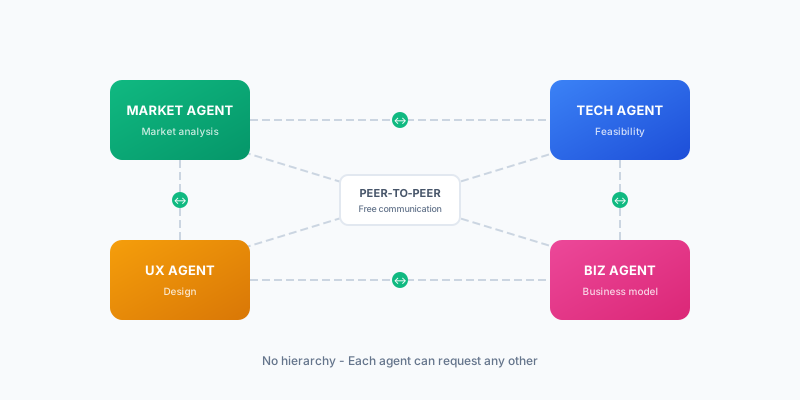
Agents communicate freely with each other without hierarchy. Each can request any other agent according to their needs. Emergent self-organization.
Diagram
When to Use
- Exploratory problems without predefined path
- Teams of agents with complementary skills
- Situations requiring adaptability
Practical Case: Product Innovation Cell
A startup develops a new SaaS product:
- Market Research Agent → Analyzes trends, competition
- UX Agent → Proposes user journeys
- Tech Agent → Evaluates technical feasibility
- Business Agent → Models the business model
Agents collaborate freely, each enriching the work of others until convergence.
4. Hierarchical — Multi-Level Supervision
The Concept
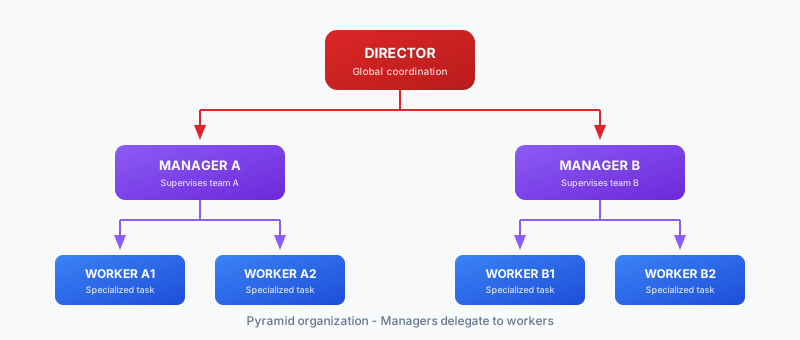
Tree organization with multiple levels of supervision. Managers delegate to sub-managers or worker agents. Scalable and structured.
Diagram
When to Use
- Complex organizations requiring delegation
- Projects with nested sub-projects
- Need for scalability with control
Practical Case: Automated Financial Audit
An accounting firm audits a multinational’s accounts:
- Director → Coordinates the global audit, consolidates conclusions
- Balance Sheet Manager → Supervises assets/liabilities analysis
- Fixed Assets Worker
- Receivables Worker
- Debts Worker
- P&L Manager → Supervises income statement analysis
- Revenue Worker
- Expenses Worker
- Balance Sheet Manager → Supervises assets/liabilities analysis
Result: Complete audit in parallel, structured anomaly escalation.
5. Fan-out/Fan-in — Parallelization and Aggregation
The Concept
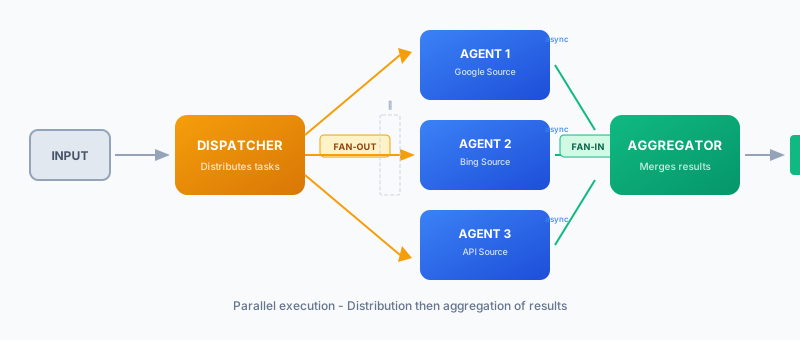
A dispatcher distributes a task to multiple agents in parallel (fan-out). An aggregator collects and synthesizes the results (fan-in).
Diagram
When to Use
- Parallelizable tasks without dependencies
- Multi-source research
- Processing time optimization
Practical Case: Competitive Intelligence
A company monitors 20 competitors:
- Dispatcher → Distributes the list of competitors
- Analyst Agents (×20 in parallel) → Each analyzes a competitor (news, patents, recruitment, social media)
- Aggregator → Synthesizes into unified report with priority alerts
Result: Exhaustive monitoring in 5 minutes instead of 2 days.
6. Evaluator/Critic — Generation + Validation
The Concept
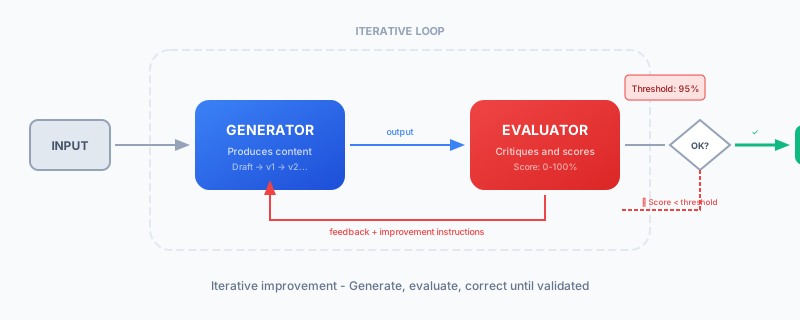
One agent generates an output, another evaluates and critiques it. Iterative loop until a quality threshold is reached.
Diagram
When to Use
- High-quality content generation
- Self-correcting code
- Any output requiring iterative validation
Practical Case: Legal Contract Drafting
A law firm automates NDA drafting:
- Generator → Drafts the contract according to parameters (parties, jurisdiction, duration)
- Evaluator → Checks:
- Legal compliance (mandatory clauses present)
- Internal consistency (no contradictions)
- Balance of obligations (no leonine clauses)
- Style (correct legal terminology)
- Loop → Iterates until score > 95%
Result: Firm-quality contracts in 3 minutes, with iteration audit trail.
7. Blackboard — Shared State + Controller
The Concept
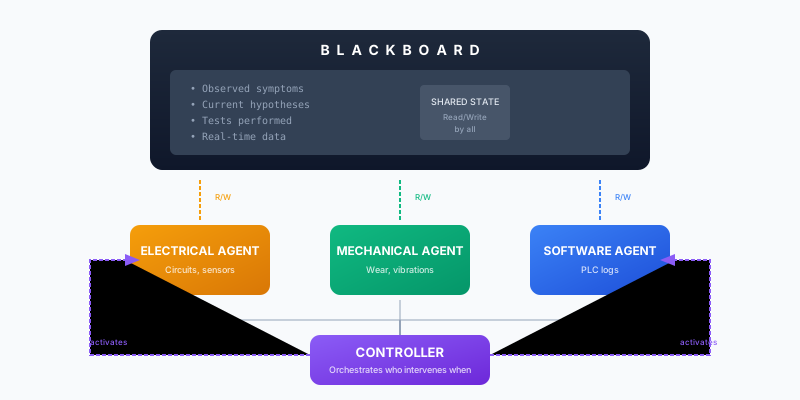
Agents share a common space (blackboard) where they read and write. A controller orchestrates who intervenes when, based on the blackboard state.
Diagram
When to Use
- Problems requiring progressive knowledge accumulation
- Complex multi-expertise diagnosis
- Situations where intervention order depends on state
Practical Case: Industrial Fault Diagnosis
An automotive factory diagnoses line stoppages:
Blackboard contains:
- Observed symptoms
- Fault hypotheses
- Tests performed
- Real-time sensor data
Specialist Agents:
- Electrical Agent → Analyzes circuits, sensors
- Mechanical Agent → Analyzes wear, vibrations
- Software Agent → Analyzes PLC logs
- Process Agent → Analyzes production parameters
Controller → Activates the relevant agent based on diagnostic state
Result: Expert diagnosis in 10 minutes, capitalization of solved cases.
8. Debate — Adversarial Argumentation
The Concept
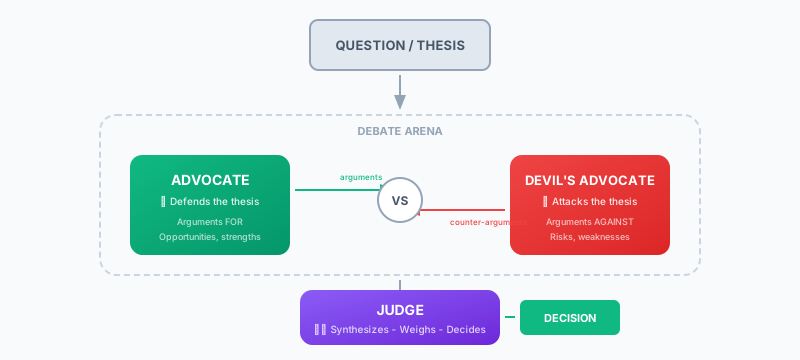
Two or more agents confront each other on a question, each defending a position. A judge decides or synthesizes. Useful for exploring pros/cons.
Diagram
When to Use
- Strategic decisions with risks
- Need to explore contradictory arguments
- Reducing confirmation bias
Practical Case: VC Investment Committee
A venture capital fund evaluates a startup:
- Advocate Agent → Defends the investment
- Market potential, team, traction, differentiation
- Devil’s Advocate Agent → Attacks the investment
- Market risks, team weaknesses, burn rate, competition
- Judge Agent → Synthesizes, weighs, recommends
- Investment score + suggested conditions
Result: Balanced due diligence, documented decisions, less enthusiasm bias.
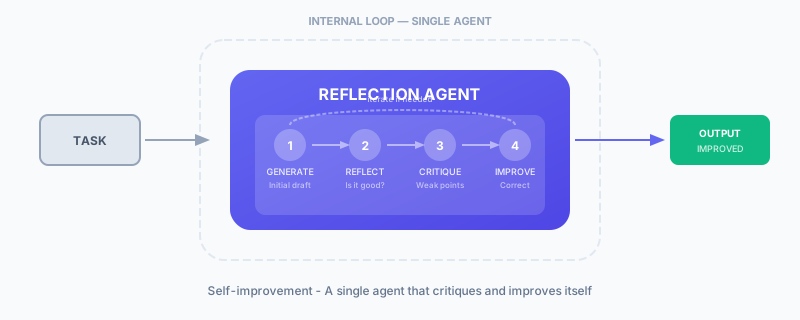
9. Reflection — Self-Critique and Improvement
The Concept
A single agent generates an output, then self-evaluates, identifies its weaknesses, and improves iteratively.
Diagram
When to Use
- Creative tasks requiring refinement
- Complex step-by-step reasoning
- When a single agent suffices but must excel
Practical Case: Strategic Presentation Preparation
A marketing director prepares a board presentation:
Reflection Agent in 4 passes:
- Draft → Generates initial structure and content
- Reflect → “Is this presentation convincing? Do the data support the thesis?”
- Critique → “Slide 4 lacks evidence. The conclusion is weak. Too much jargon.”
- Improve → Corrects identified weaknesses
Result: Consulting-quality presentation, self-improved in 3 iterations.
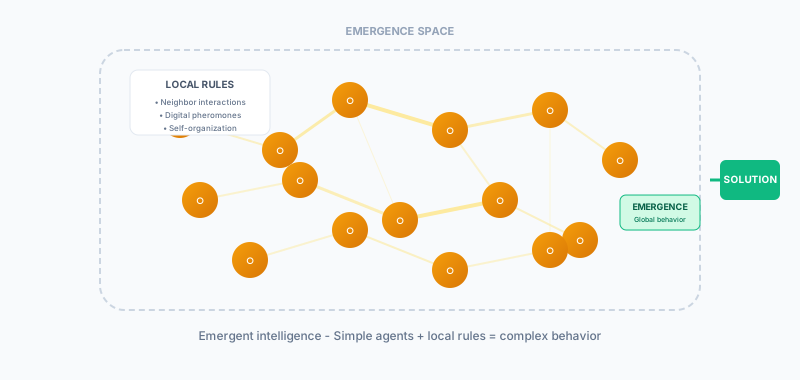
10. Swarm — Emergent Collective Intelligence
The Concept
Many simple agents interact locally according to simple rules. Intelligent behavior emerges from these interactions.
Diagram
When to Use
- Massive exploration of solution spaces
- Combinatorial optimization
- Adaptive and resilient systems
Practical Case: Last-Mile Logistics Optimization
An e-commerce company optimizes 500 daily deliveries:
Swarm of micro-agents (1 per package):
- Each agent knows: origin, destination, time constraints
- Local rules: “If a neighbor is going in my direction, propose grouping”
- Digital pheromones: Good routes are reinforced
Emergence: Optimal routes form organically through local aggregation
Result: -23% kilometers traveled, real-time adaptation to disruptions.
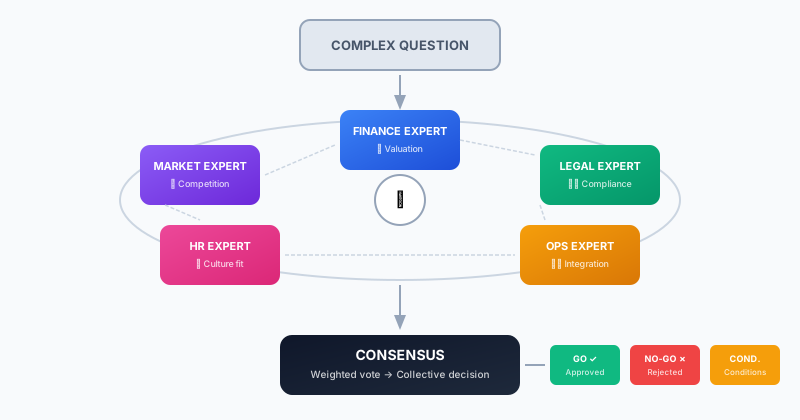
11. Council / Ensemble — Multi-Expert Deliberation
The Concept
Multiple expert agents deliberate together on a question. Each brings their perspective, then the group converges toward a collective decision.
Diagram
When to Use
- Complex multi-dimensional decisions
- Need to cross multiple expertises
- Reducing error risk through redundancy
Practical Case: M&A Project Evaluation
An industrial group evaluates an acquisition target:
Expert Council:
- Finance Expert → Valuation, synergies, deal structure
- Legal Expert → Legal due diligence, litigation risks
- Operations Expert → Industrial integration, operational synergies
- HR Expert → Culture fit, key talent retention
- Market Expert → Competitive positioning post-merger
Deliberation: Each expert shares their analysis, others challenge
Consensus: Weighted vote → Go / No-Go / Conditions
Result: Robust decision, minimized blind spots, complete documentation.
Summary Table
| Pattern | Complexity | Control | Typical Use Case |
|---|---|---|---|
| Pipeline | ⭐ | Strict | ETL, linear workflows |
| Supervisor | ⭐⭐ | Centralized | Routing, customer support |
| Collaborative | ⭐⭐⭐ | Distributed | Innovation, exploration |
| Hierarchical | ⭐⭐⭐ | Pyramidal | Audit, large projects |
| Fan-out/Fan-in | ⭐⭐ | Parallel | Multi-source research |
| Evaluator/Critic | ⭐⭐ | Iterative | Quality generation |
| Blackboard | ⭐⭐⭐ | Shared state | Complex diagnosis |
| Debate | ⭐⭐ | Adversarial | Strategic decisions |
| Reflection | ⭐ | Self | Creative refinement |
| Swarm | ⭐⭐⭐⭐ | Emergent | Massive optimization |
| Council | ⭐⭐⭐ | Deliberative | Multi-expert decisions |
How to Choose?
Ask yourself these questions:
-
Is the task sequential or parallelizable?
- Sequential → Pipeline
- Parallelizable → Fan-out/Fan-in
-
Do I need centralized control?
- Yes → Supervisor or Hierarchical
- No → Collaborative or Swarm
-
Does quality take priority over speed?
- Yes → Evaluator/Critic or Reflection
- No → Direct Pipeline
-
Does the problem require multiple expertises?
- Yes, in sequence → Pipeline
- Yes, in parallel → Council or Fan-out
- Yes, with debate → Debate
-
Does the problem state evolve?
- Yes, shared state needed → Blackboard
- No → Other patterns
Conclusion
These 11 patterns are not mutually exclusive. The most powerful multi-agent architectures combine multiple patterns:
- A Supervisor that routes to specialized Pipelines
- A Council where each expert uses an internal Evaluator/Critic
- A Blackboard fed by a Swarm of collector agents
The key is understanding each pattern’s strengths and assembling them like Lego bricks to build the architecture suited to your problem.
Multi-agent orchestration is not about technology, it’s about design. Choose the right pattern, and your agents will work together like a cohesive team.
Further Reading
- AI Agent Design Guide: What Works, What Fails — The golden rule of deterministic feedback, decision matrices and design principles
- Meta-Analysis: Capabilities, Limitations and Patterns of AI Agents — Analysis of 100+ publications: viable patterns vs illusions
- Building an Agent: The Art of Assembling the Right Building Blocks — Languages, orchestration frameworks, models and infrastructure
- Agent Skills: The Onboarding Manual — Structuring instructions for specialized agents
About
by Intent