 AiBrain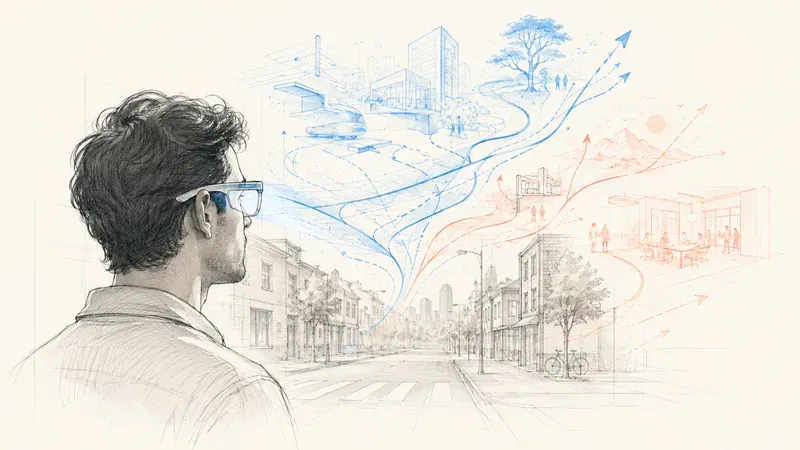
Executive Summary
Observation: we still evaluate AI through the grammar of speed: hours saved, costs reduced, cycles shortened.
Thesis: the real shift is not only temporal. AI changes what we can reasonably demand, explore, and want to produce.
Key point: if we only ask AI to accelerate the old world, we miss the moment where it can open a more ambitious space for creation.
Implication: the right question is not only “how much time do I save”, but “what can I now afford to demand?”
And as long as we only ask it for that, we are applying a small-game strategy.
The transformations that matter almost never begin with a decision. They do not come down from an executive committee, they are not voted on, they do not appear in any strategic plan before they have already happened. They begin with people. A few people at first, who start working differently, without permission, without a method, without even a name yet for what they are doing.
With AI, this is already underway. Somewhere right now, a developer, a designer, someone tinkering at night, is exploring a way to produce value that no one asked them to produce. It does not show up in any dashboard. It does not have a job title yet. And eventually, organizations themselves will be transformed by it, not because of strategy, but because they will be caught up by what their own teams have started doing. The way they propose value will change. The way they build it too. And, inevitably, the way they measure it, because today’s counters do not know how to count what is being created now.
But we are not there yet. Today, we still all speak the same language. A very simple, very old, very reassuring language: the language of speed.
Speed as a common grammar
Speed has become the shared language between worlds that rarely understand one another. On the decision-maker side, it is used to steer: deadlines, budgets, time-to-market, resource allocation. On the team side, it is used to justify: complexity, load, technical debt, the quality we did not have time to reach. One side asks “when will it ship”, the other answers “not before this date, and here is why”. Everyone talks about when it comes out.
This is not absurd. In a constrained world, speed is a convenient metric. It has the merit of making comparable things that are not really comparable: a feature and an idea, a decision and a product, one team and another. We do not always know how to say whether one thing is worth more than another, but we always know how to say which one arrived first.
Over time, speed stopped being a mere indicator. It became a grammar. We no longer think only in terms of value, but in terms of the acceptable delay required to produce that value. The question “what is this worth” slowly faded behind the question “how long will it take”. And a grammar, unlike an indicator, is no longer noticed: we think through it, not about it.
Speed did not only measure work. It eventually organized our imagination of work.
AI arrives, and we run the old-world calculation
AI produces a real, massive, immediate speed gain. Denying that would be ridiculous, and it would be posturing. Writing, coding, summarizing, prototyping, documenting, comparing, correcting, translating, exploring: everything accelerates, sometimes in proportions we would not have believed possible two years ago.
The first reflex, then, is perfectly rational. We translate that gain into the only language we know: we convert it into cost, ROI, headcount, planning, shorter timelines. How many hours saved, how many roles redeployed, how many days won on the next cycle. It is reasonable. It is even responsible. And that is exactly where the trap begins.
Because we are applying the calculation of the world before to a tool from the world after. We were given a new territory, and our first question was: how much does the fence cost?
This is where things need to be named, and I will do it directly, because it is the heart of the text. Going faster with AI is a small-game strategy. Let me be clear right away: reasonable, profitable, defensible. It pays off immediately, reassures everyone, and fits easily into Excel spreadsheets. I am not saying we are small-game people. I am saying we inherited a strategy that is, and we have not noticed it yet. It asks no one to change their definition of value. It takes the old world and makes it spin faster.
We are not wrong to go faster. We are simply looking at the wrong dial.
What really broke open
Here is the point I want to make stand up, because everything else follows from it. Speed was not only constraining our timelines. Silently, it was constraining two much deeper things, and their release, not the time gain, is the real event.
The first is ambition of scope. We were not only defining what had to be done. We were defining, without always admitting it, what we could reasonably hope to finish. Scope was a function of available time. We cut, trimmed, postponed, and called it prioritization. Part of it was. Another part was simply the calendar deciding the size of our dreams for us.
The second is the level of standards. We often knew how to do better. Better structure the code, better test, better write, better document, better explore an alternative we had dismissed too quickly, better understand a problem before jumping to the solution. We knew. But “better” cost time, and the time was already taken. So we did something acceptable, and called it realism.
Part of what we called realism may simply have been a permanent negotiation with slowness.
With AI, these two sliders move. Not magically, not automatically, not without method or judgment. But they move. And as soon as they move, the real question is no longer “how do I do the same thing faster”. It becomes: what can I now afford to demand? And, even more uncomfortable: what had I learned to stop wanting?
That last question is uncomfortable because it sends us back to ourselves. It suggests that after enough time negotiating with constraint, we ended up internalizing constraint as a preference. We confused what we could not do with what we did not care to do. By lifting part of the blockage, AI forces us to rediscover desires we had carefully filed under “not realistic”.
The virgin forest before the roads
This moment is particular, and it will not last, because nothing is stabilized yet. Organizations are beginning to integrate AI, but they have not digested it. They have not yet turned everything into procedures, KPIs, evaluation grids, HR processes, productivity standards, checkboxes. The work of normalization is ahead of us, not behind us.
For now, a wild zone remains. For now, AI is not yet a highway. It is a forest.
I care about this metaphor because it says the opposite of what we hear everywhere. The dominant discourse talks about an opportunity that is closing, a train we must not miss, a delay to make up before others do. That is temporal scarcity, anxious consulting FOMO, and it puts us right back into the grammar of speed we should be leaving. A forest is not a window. It is not a resource that gets depleted while we hesitate. It is an unmapped, dense, living space, where we still move forward with a machete, through intuition, tinkering, curiosity. And that is precisely what makes the moment interesting.
Individuals are the ones who enter it first, never organizations. Explorers always come before roads. Someone traces a path because they wanted to see what was behind it, and only much later do we pave it, put up signs, and charge a toll.
The point, then, is not to run faster than the others. The point is to accept walking off the already traced paths. The nuance matters: running assumes a track and a finish line, walking off paths assumes we do not yet know where we are going, and we go anyway.
When the roads arrive (and they will), it will be simpler, safer, more industrialized. It will also be less free. Today, using AI can still be an act of personal exploration, not only an enterprise procedure. That window, the window of exploration before the norm, is the only one that is truly closing.
Take your machete and your compass
This text is not a how-to. It is not a seven-step method, and offering one would be contradictory anyway, since methods are precisely the roads that do not exist yet. It is the sharing of a perception: something has shifted, and once you have felt it, you cannot unfeel it.
We thought AI would mostly reduce the time needed to produce. It is starting to reduce something else, something more intimate: the distance between an ambitious idea and its first incarnation. The gap between “I wonder whether we could” and “here is a first version” has collapsed. And it was that gap, more than time, that discouraged most ambitions before they were even formulated.
The forest is not crossed with a stopwatch. It is crossed with a machete to open the way, and a compass to keep a heading. Not a route, a heading. The nuance matters: a route assumes the path is already known, a compass only assumes that we know which direction we want to go, even without knowing where we will pass. We do not enter this forest to save time. We enter it to discover what we did not know how to search for.
And maybe this is where the real split appears. On one side, the stopwatch, which tells us how long. On the other, the compass, which tells us where to. We spent years perfecting the first. We somewhat forgot the second.
If our only question when facing AI is still “how much time do I save”, then maybe we are still standing at the edge, stopwatch in hand, measuring the terrain instead of entering it.
Harder, Better, Faster, Stronger. I wonder what the song would have become if it had been called Faster, Faster, Faster, Faster. Nothing left to listen to. Just a loop accelerating toward nowhere.