 AiBrain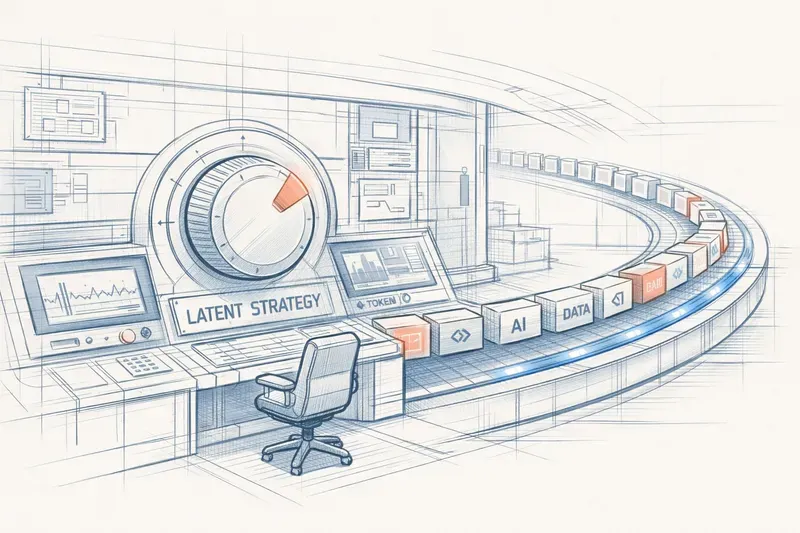
Executive Summary
Observation: Autoregressive Transformers make decisions token by token, without a mechanism to plan a global strategy before generating.
Innovation: Meta’s Free Transformer injects a learned latent vector (via VAE) that encodes “high-level decisions” that then condition the entire generation. Result: +30-40% on reasoning and code benchmarks, for only 3% compute overhead.
Limitation: Experiments limited to 8B parameters, code not public, out-of-distribution robustness undocumented. Promising but not validated at frontier model scale.
Glossary: Understanding Technical Terms
- Autoregressive
- Generation mode where each word (token) is predicted based solely on previous words, like writing a sentence without being able to go back. This is the standard operation of GPT, Claude, and all current LLMs. Simple and efficient, but forces local decisions without global vision.
- Latent variable
- A “hidden” variable that is not directly observable but influences the system’s behavior. Imagine a chef who mentally decides “I’m going to make a spicy dish” before starting—this decision doesn’t appear in the written recipe, but it guides all their ingredient choices. The Free Transformer learns this type of implicit decisions.
- VAE (Variational Autoencoder)
- A learning architecture that compresses information into a compact vector (the latent space), then reconstructs it. Like learning to summarize a book in a key sentence, then rewriting the book from that sentence. The Free Transformer uses this technique to learn which “global decisions” are useful.
- ELBO (Evidence Lower Bound)
- A mathematical function that measures both reconstruction quality and latent space regularity. In practice, it’s the score the model optimizes during training—the higher it is, the better the model learns to use its latent variables.
- Posterior collapse
- A classic VAE failure where the model learns to completely ignore the latent variable and falls back to standard operation. It’s as if the chef forgot their initial decision and improvised each ingredient randomly—the dish may be correct, but global coherence is lost.
- Scaling
- Behavior of a technique when increasing model size (parameters) or data. A technique that “scales well” maintains its advantages on large models. The Free Transformer has only been tested at 8 billion parameters—we don’t know if it scales to the 70B+ of state-of-the-art.
Modern language models generate text word by word, or rather token by token, in a strictly sequential process. This autoregressive approach, which has made Transformers successful since 2017, hides a fundamental limitation: some decisions shouldn’t be made so rigidly. When you solve a math problem, you don’t mechanically decide on the next word to write—you first plan a global strategy, then execute it. This is precisely the intuition that the Free Transformer, developed by Meta AI, attempts to capture by introducing latent variables learned in an unsupervised manner into the generation process.
The architecture promises substantial gains on reasoning and code tasks: +30% on GSM8K, +35% on MBPP, +40% on HumanEval for a 1.5 billion parameter model, with only 3% computational overhead. But these impressive results come with shadows: experiments stop at 8 billion parameters, the code is not public, and out-of-distribution robustness remains undocumented.
Why do autoregressive Transformers struggle on structured tasks?
Pure autoregressivity imposes a simple but costly constraint: each token depends solely on previous tokens. This chain rule is theoretically sufficient to model any probability distribution—we can always decompose a joint probability into a product of conditional probabilities. The problem isn’t theoretical, it’s practical.
Take the canonical example of repeated coin flips, used in the original paper to illustrate the concept. Imagine you need to generate a sequence of 100 coin flips, but these flips follow a hidden pattern: either all even flips give heads (pattern A), or all even flips give tails (pattern B). A standard autoregressive model must encode this global decision implicitly, distributing it across all tokens it generates. It has no explicit mechanism to say “I chose pattern A” at the start, then generate accordingly. Instead, it must maintain this information diffusely in its internal representations, which becomes exponentially more difficult as the sequence lengthens.
Mathematical reasoning tasks or code generation exhibit exactly this type of structure. Solving a quadratic equation requires choosing an approach (factoring, quadratic formula, completing the square), then executing this approach coherently across several steps. A pure autoregressive model must “guess” this strategy token by token, without ever having explicitly decided it. It’s like trying to build a house by deciding where to place each brick individually, without a global architectural plan.
The important nuance here: it’s not that standard Transformers can’t learn these patterns. With enough data and parameters, they do. But they do so inefficiently, encoding global decisions in millions of local micro-decisions. The Free Transformer proposes an alternative: explicitly capture some of these decisions via latent variables.
Anatomy of the Free Transformer
The Free Transformer architecture extends the classic Transformer decoder by injecting a latent vector Z at each generation step. Concretely, this vector of dimension 2^H (where H is the number of attention heads) is sampled at the start of generation and then conditions the production of all tokens.
Training follows the Variational Autoencoders (VAE) paradigm. The model simultaneously learns two distributions: a uniform prior distribution P(Z) on the latent space, and a posterior distribution Q(Z|x,y) that infers the correct latent vector given input x and target output y. This posterior distribution is computed by a hybrid encoder that combines causal blocks (respecting temporal order) and a final non-causal block that can “see” the entire sequence to extract global patterns.
During training, the model uses the encoder to obtain an informative Z, then learns to generate the target sequence conditioned on this Z. The objective is a classic VAE ELBO (Evidence Lower Bound): maximize generation probability while regularizing the KL divergence between the posterior distribution and the prior. This regularization forces the model to use “generic” latents rather than overfitting to specific patterns in the training dataset.
At inference, the encoder is no longer available since we don’t yet know the output. The model simply samples Z from the uniform prior distribution, then generates autoregressively conditioned on this Z. This is where the magic happens: if training succeeded, different Z should correspond to different “resolution strategies,” and random sampling of Z allows the model to explore these strategies.
The architectural overhead is minimal: a single additional Transformer block for the encoder, about 3% additional compute according to Meta’s measurements. The implementation reuses the same attention mechanisms as the standard decoder, which facilitates integration into existing frameworks. The latent vector dimension (2^H) is chosen to naturally correspond to the multi-head structure of the Transformer, although the paper doesn’t explicitly justify this dimensional choice.
Results: Concrete Gains on Benchmarks
The numbers reported by Meta are impressive on reasoning and code tasks. On GSM8K, the standard benchmark of elementary school-level math problems, the Free Transformer at 1.5 billion parameters achieves a 30% improvement compared to a Transformer baseline of the same size trained under the same conditions. On MBPP (Mostly Basic Python Problems), the gain reaches 35%, and on HumanEval, the Python code generation benchmark, the improvement peaks at 40%.
These performances are maintained when scaling to 8 billion parameters, although relative gains seem to slightly decrease—a classic pattern where larger architectures partially compensate for algorithmic limitations through brute capacity. Unfortunately, the paper doesn’t provide detailed scaling curves, which limits analysis of this trend.
A crucial point: all these results come from models trained from scratch, not fine-tuning of existing models. This is both a strength and a limitation. Strength, because it demonstrates that the architecture truly brings something, not just a regularization effect on a pre-trained model. Limitation, because the practical question for most practitioners is: “Can I improve my existing LLaMA or Mistral with this technique?” The answer remains unclear.
The absence of public code complicates independent validation. Implementation details that often make the difference between a paper and a production system—weight initialization, KL regularization hyperparameters, curriculum learning strategies to balance prior and posterior—are not all documented. The paper mentions a coefficient β for KL divergence that progressively increases during training, but doesn’t give the exact schedule.
The chosen benchmarks—GSM8K, MBPP, HumanEval—are all structured tasks where the latent variable hypothesis makes sense. We would have liked to see results on more open tasks like creative text generation or conversation, to understand if latents also help in these less structured contexts. Their absence suggests either that gains are negligible, or that experiments haven’t yet been conducted.
Implications for Generative AI
The Free Transformer fits into a broader trend: exploring latent space to improve reasoning. OpenAI’s o1 models and DeepSeek-R1 also use forms of “latent reasoning,” but in token space via hidden chains of thought. The fundamental difference: the Free Transformer operates in a continuous latent space learned in an unsupervised manner, while o1 likely uses reinforcement learning on explicit reasoning tokens.
This distinction has practical consequences. The Free Transformer’s continuous latents are more compact—a vector of a few thousand dimensions versus potentially hundreds of reasoning tokens. They’re also more opaque: impossible to inspect what a particular latent vector “means,” unlike a chain of thought in natural language. The trade-off is classic: computational efficiency versus interpretability.
The potential for multimodal tasks deserves attention. VAEs have a long history in image generation, and the idea of conditioning text generation on latents could naturally extend to joint text-image or text-video generation. A latent vector could encode global decisions like “photographic style” or “narrative tone” that then consistently influence all generated tokens. The paper doesn’t explore this direction, but the architecture seems compatible.
The main risk lies in the quality of learned latents. If training fails to capture the right abstractions—if sampled Z don’t correspond to coherent resolution strategies—the model loses the advantages of latents while keeping the computational overhead. VAEs are notorious for “posterior collapse,” where the model learns to ignore Z and falls back to a pure autoregressive model. The paper doesn’t explicitly discuss this risk or the techniques used to avoid it, beyond progressive KL regularization.
Scalability remains the great unknown. Experiments stop at 8 billion parameters, far from the 70B+ that define current state-of-the-art. Do gains persist? Does the 3% overhead remain constant or increase? Do very large models already implicitly learn equivalent latent representations, making the explicit architecture redundant? Without experiments at this scale, it’s difficult to predict whether the Free Transformer will become a standard component of future LLMs or remain an interesting but unadopted academic curiosity.
Out-of-distribution robustness constitutes another shadow zone. The tested benchmarks are all in-distribution relative to training data. What happens when the model encounters a radically different type of problem, where learned latents are no longer relevant? A pure autoregressive model can at least fall back on its general sequential modeling capacity. A poorly trained Free Transformer might sample inappropriate Z and produce incoherent results. This robustness question isn’t addressed in the paper.
The Free Transformer proposes an elegant answer to a real limitation of pure autoregressive architectures: the inability to explicitly make global decisions before generating. By introducing latent variables via a VAE framework, Meta demonstrates substantial gains on structured tasks with minimal overhead. But between a proof of concept at 8B parameters and a production component in future 100B+ parameter models, the path remains to be traveled. The absence of public code, open questions on scalability and robustness, and lack of direct comparisons with alternative approaches like o1’s latent chains of thought temper enthusiasm. The idea is promising; its practical impact will be measured in the coming months, if and when other teams reproduce and extend these results.